

Ride Sharing Market Share Accelerate to Reach USD 283 billion, at a CAGR of 10.1% During the Forecast 2026–2035
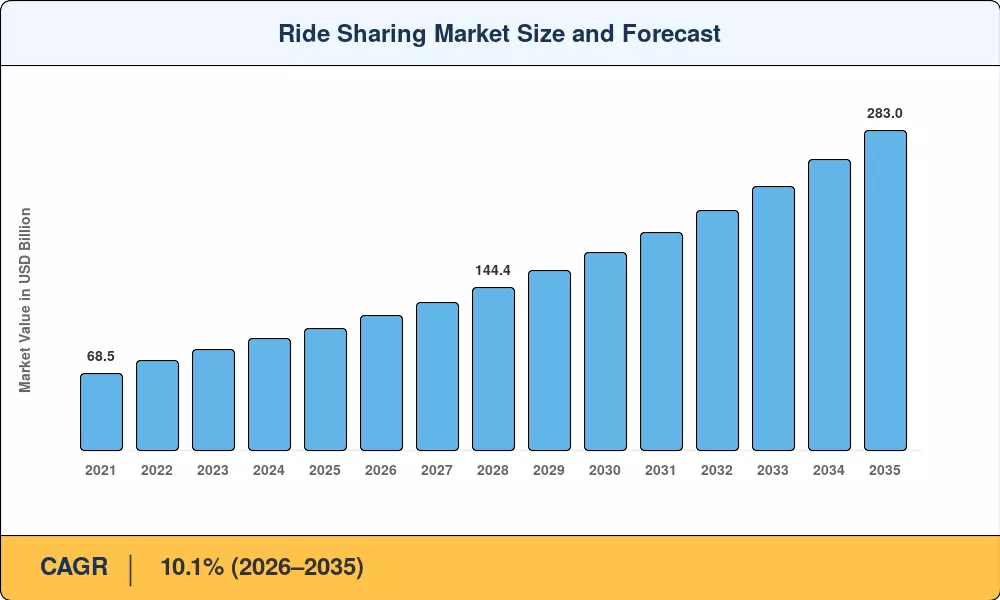
Ride Sharing Market Summary
Ride pooling shared is the fastest-growing segment with a projected CAGR of 13.4%, fueled by cost-conscious urban commuters and municipal HOV-lane incentives
NY, CA, UNITED STATES, June 22, 2026 /EINPresswire.com/ -- Ride Sharing Market to Hit USD 283.0 Billion by 2035 at 10.1% CAGRThe Ride Sharing Market reached an estimated USD 108.2 billion in 2025 and is projected to grow from USD 119.1 billion in 2026 to USD 283.0 billion by 2035, registering a CAGR of 10.1% during the forecast period (2026–2035).
Ride Sharing Market Overview
The ride sharing market trends encompasses digital platforms and services that connect passengers with drivers for on-demand mobility, including ride-hailing, ride pooling, car rental subscriptions, and micro-transit solutions. This market leverages mobile applications, GPS technology, and sophisticated algorithms to match supply with demand, optimize routes, and dynamically price services. The ride sharing ecosystem includes platform operators, independent drivers, fleet owners, and technology providers that collectively enable convenient, efficient urban mobility alternatives to private vehicle ownership and traditional taxi services.
The market is experiencing robust growth driven by several fundamental factors. Aggressive urban congestion-reduction mandates across G20 nations and cumulative venture-plus-corporate investment exceeding USD 42 billion since 2021 into ride-hailing platform technologies have transformed ride sharing from a convenience play into embedded municipal infrastructure. According to UN estimates, 2.5 billion more people will live in cities by 2050, accounting for 68% of the world's population, creating unprecedented demand for efficient mobility solutions.
Industry trends indicate a decisive shift toward algorithmically optimized ride pooling, real-time dynamic pricing engines, and increasingly autonomous robotaxi pilots. The integration of ride sharing with public transit, corporate commute programs, and super-app ecosystems is expanding the market beyond personal mobility. Corporate ride sharing employee commute programs now represent a fast-expanding adjacency, with platforms securing enterprise contracts worth hundreds of millions annually.
Technological developments are reshaping the ride sharing landscape. Autonomous robotaxi deployment is accelerating, with Waymo exceeding 150,000 paid autonomous rides per week across multiple U.S. cities by late 2024. AI-based fleet rebalancing, predictive demand modeling, and vehicle health monitoring are reducing platform operating costs. Electric vehicle integration is advancing rapidly, with major platforms committing to zero-emission fleet transitions. The convergence of ride sharing with autonomous driving, electrification, and mobility-as-a-service platforms is creating new business models and revenue streams.
Policy and regulatory influence on the ride sharing market is significant. The EU's Platform Work Directive, adopted in 2024, establishes a legal presumption of employment for gig workers meeting specific criteria, forcing platforms to reclassify drivers or restructure engagement models. California's Clean Miles Standard mandates that 90% of ride-hailing vehicle miles be zero-emission by 2030, while similar electrification timelines are being pushed under the EU's "Fit for 55" plan. Congestion pricing zones in London, Stockholm, Singapore, and New York directly encourage ride-pooling over single-occupancy car travel.
The demand outlook remains strongly positive, supported by urbanization, declining vehicle ownership rates among younger demographics, and increasing consumer preference for on-demand mobility. The rise of remote and hybrid work models has created new demand patterns, with corporate ride sharing employee commute programs expanding significantly. As autonomous robotaxi services scale from pilot to commercial deployment, the ride sharing market stands at an inflection point that will redefine urban mobility through 2035.
📍 Get Free Sample Report for Detailed Market Insights:
https://www.marketresearchfuture.com/sample_request/7444
Ride Sharing Market Segmentation
By Service Type
The ride sharing market is segmented by service type into ride-hailing, ride pooling/shared trips, car rental/subscription, and micro-transit/shuttle services. Ride-hailing services hold the largest revenue share at approximately 62% of the market, sustained by dominant platform operators Uber and Lyft in Western markets and Grab and DiDi in Asia. Ride-hailing remains the backbone of the market, generating the majority of platform revenues through single-rider, on-demand trips. Uber and Lyft together account for over 70% of U.S. ride-hailing volume.
Ride pooling/shared trips is the fastest-growing segment with a projected CAGR of 13.4%, fueled by cost-conscious urban commuters and municipal HOV-lane incentives. Algorithms now achieve 85%+ match rates in dense urban corridors, reducing per-rider costs by 30–40% versus solo trips. Car rental and subscription services, valued at approximately USD 11.2 billion in 2025, offer flexible ownership alternatives appealing to consumers seeking mobility without vehicle ownership. Micro-transit and shuttle services, growing at 11.8% CAGR, are increasingly driven by corporate ride sharing employee commute programs and government partnerships for first/last-mile transit gap solutions.
By Application
Application segmentation covers personal mobility, corporate/enterprise, and government/public transit integration. Personal mobility dominates at roughly 74% share of the ride sharing market, reflecting consumer reliance on on-demand transport for daily commutes, leisure activities, and airport transfers. The convenience and accessibility of app-based ride-hailing have made it an essential component of modern urban living.
Corporate/enterprise applications are expanding at a 14.1% CAGR as employers subsidize last-mile connectivity for employees. A 2024 Global Workplace Analytics study found 62% of Fortune 500 companies now subsidize employee commute programs through ride sharing platforms. Corporate ride sharing employee commute spending reached an estimated USD 8.3 billion globally in 2025, with platforms capturing most enterprise contracts through managed mobility programs.
Government/public transit integration, valued at USD 4.6 billion in 2025, represents a growing opportunity as municipalities partner with ride sharing platforms to supplement public transit. Services such as Dallas Area Rapid Transit's Via-powered micro-transit service illustrate how ride-sharing platforms are supplementing rather than replacing public transit, providing efficient first/last-mile connectivity.
By Vehicle Propulsion
Propulsion segmentation includes internal combustion engine vehicles, battery electric vehicles, and hybrid vehicles. ICE vehicles currently hold the largest share at approximately 61% of the market, though this share is declining as electrification accelerates. Electric vehicle ride sharing fleet penetration across major platforms is expected to reach 40–50% by 2030 and exceed 75% by 2035.
Battery electric vehicles represent the fastest-growing segment with a CAGR of 18.2%, driven by regulatory mandates and lower total cost of ownership. Platforms operating BEV-heavy fleets in cities like Shenzhen and Oslo report 35–45% lower per-mile fuel-and-maintenance costs versus ICE equivalents. Hybrid vehicles, valued at USD 14.8 billion, serve as a transition bridge in markets lacking comprehensive charging infrastructure.
By Region
Regional segmentation includes North America, Europe, Asia-Pacific, South America, and the Middle East and Africa. North America commands roughly 38% of the global ride sharing market, driven by deep smartphone penetration and mature ride-hailing platform ecosystems in the United States. Asia-Pacific is the fastest-growing region at a projected CAGR of 12.6%, propelled by urbanization surges in India, Indonesia, and Vietnam. Europe holds approximately 25% share, supported by stringent emissions standards that accelerate electric vehicle fleet adoption.
🛒 You can buy this market report at:
https://www.marketresearchfuture.com/checkout?currency=one_user-USD&report_id=7444
Ride Sharing Market Competitive Landscape
The ride sharing market exhibits moderate-to-high concentration, with an estimated HHI of approximately 1,800–2,200 across the top 15 global markets. The top five platforms collectively capture an estimated 65–70% of global gross bookings, though regional composition varies significantly. Competition spans global ride-hailing platforms, regional super-app operators, and specialized B2B providers.
Key companies operating in this market include Uber Technologies (~28-32% revenue share), providing ride-hailing, UberPool, Uber for Business, and autonomous partnerships with global scale leadership. DiDi Global (~18-22%) dominates China and Latin America with ride-hailing, carpooling, and autonomous pilots. Lyft (~6-9%) focuses on the U.S./Canada market with ride-hailing, shared rides, and bike/scooter rentals.
Grab Holdings (~5-7%) operates a super-app ecosystem in Southeast Asia integrating rides, delivery, and payments. Bolt (Taxify) (~3-5%) expands across Europe and Africa with ride-hailing, micro-mobility, and food delivery. Ola Cabs (~3-5%) leads India's market as an electric vehicle ride sharing fleet pioneer. BlaBlaCar (~2-3%) specializes in long-distance ride pooling and bus marketplace services across Europe. Via Transportation (~1-2%) offers B2B transit-as-a-service and micro-transit solutions. Waymo (Alphabet) (~1-2%) leads autonomous robotaxi service with a technology-first, driverless-only model. Careem (Uber) (~1-2%) operates a ride-hailing and payments super-app across the Middle East and North Africa.
Vendors are differentiating through super-app integration, autonomous technology investment, corporate mobility solutions, and sustainability commitments. The market is shifting toward platform consolidation as profitability pressures mount, enabling scale economics necessary to fund autonomous and electric transitions.
Latest Industry News & Developments
Waymo (October 2024): Expanded autonomous robotaxi ride sharing service to Los Angeles, reaching 100,000+ weekly paid rides across three U.S. cities. This expansion represents the most tangible proof point for autonomous robotaxi ride sharing at commercial scale.
Uber Technologies (August 2024): Announced partnership with BYD to deploy 100,000 electric vehicles on the ride-hailing platform globally by 2027, accelerating electric vehicle ride sharing fleet targets and demonstrating commitment to zero-emission mobility.
European Union (April 2024): Adopted the Platform Work Directive, establishing employment presumption criteria affecting ride sharing regulation insurance liability frameworks across 27 member states. This legislation reshapes the competitive landscape by formalizing driver protections.
Grab Holdings (January 2024): Launched GrabPool AI-optimized ride pooling shared trip matching in Jakarta and Bangkok, reporting 22% higher match rates versus the previous algorithm, demonstrating the impact of advanced matching technology.
Lyft (March 2025): Introduced "Lyft Autonomous" branding for its Motional-powered robotaxi service in Las Vegas, the first U.S. ride-hailing platform to offer scheduled driverless rides. Lyft also expanded its presence to 11 countries and almost 1,000 cities by completing the acquisition of FREENOW for EUR 175 million (USD 191 million).
Waymo (June 2025): Launched a commercial robotaxi service in Atlanta with Uber, using driverless Jaguar I-PACE vehicles to span 65 square miles, further validating the autonomous ride sharing business model.
To explore more market insights, visit us at:
https://www.marketresearchfuture.com/reports/ride-sharing-market-7444
The ride sharing market is positioned for exceptional growth through 2035, driven by urbanization, technological innovation in autonomous and electric vehicles, and evolving consumer preferences for on-demand mobility. The projected valuation of USD 283.0 billion reflects robust demand across ride-hailing, ride pooling, and micro-transit segments, with autonomous and electric solutions capturing an increasing share of market value.
The medium-term growth outlook remains strongly positive, supported by the expansion of corporate ride sharing employee commute programs, government partnerships for public transit integration, and the scaling of autonomous robotaxi services. North America will continue to maintain its dominant position through mature ride-hailing ecosystems and autonomous technology leadership, while Asia-Pacific will lead market expansion with rapid urbanization, super-app integration, and government support for smart mobility.
Long-term industry potential extends beyond the current forecast horizon, as the convergence of autonomous driving, electrification, and mobility-as-a-service platforms creates new use cases and business models. The removal of driver costs through automation could compress fares by 40%, expanding the addressable rider pool significantly. Companies that successfully navigate regulatory complexity, invest in autonomous and electric technologies, and build integrated mobility ecosystems will capture disproportionate value in this evolving market. As ride sharing becomes embedded municipal infrastructure rather than a convenience service, its transformative impact on urban mobility will continue to reshape cities and transportation systems worldwide.
More Related Reports from MRFR Library:
https://www.marketresearchfuture.com/reports/agricultural-tractor-machinery-market-65851
https://www.marketresearchfuture.com/reports/autonomous-passenger-car-market-65995
https://www.marketresearchfuture.com/reports/commercial-tire-market-66264
https://www.marketresearchfuture.com/reports/electric-car-market-66567
https://www.marketresearchfuture.com/reports/electric-vehicle-battery-manufacturing-market-66579
https://www.marketresearchfuture.com/reports/electric-vehicle-supply-equipment-market-66586
https://www.marketresearchfuture.com/reports/food-truck-services-market-66806
https://www.marketresearchfuture.com/reports/smart-valet-app-market-67850
https://www.marketresearchfuture.com/reports/suv-market-67961
https://www.marketresearchfuture.com/reports/tyre-manufacturers-market-68059
Larry Wilson
WantStats Research And Media Pvt. Ltd.
+1 855-661-4441
email us here
Visit us on social media:
LinkedIn
Facebook
YouTube
X
Legal Disclaimer:
EIN Presswire provides this news content "as is" without warranty of any kind. We do not accept any responsibility or liability for the accuracy, content, images, videos, licenses, completeness, legality, or reliability of the information contained in this article. If you have any complaints or copyright issues related to this article, kindly contact the author above.
